Our manufacturing operations are complemented by the Company’s own materials testing laboratory and technology base in innovative solutions for the recovery and conversion of low-temperature heat into useful media – cooling, hot water and drinking water (including desalination and wastewater treatment technologies). NET’s dynamic growth naturally led to the expansion of the company’s activities to include a laboratory equipped with advanced, state-of-the-art research instruments. In addition to commissioned analyses and tests, our laboratory also conducts its own research into advanced materials technologies.
Our instruments
Our laboratory is equipped with high-quality research instruments.
We offer testing using:
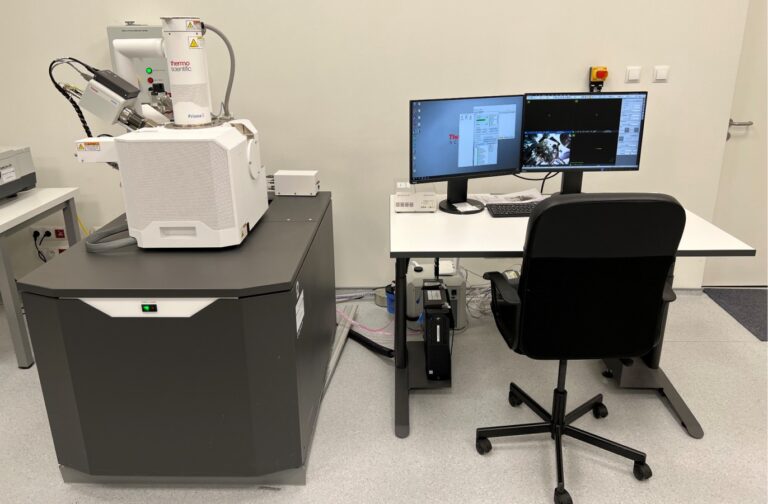
an advanced Thermo Scientific Prisma E scanning electron microscope
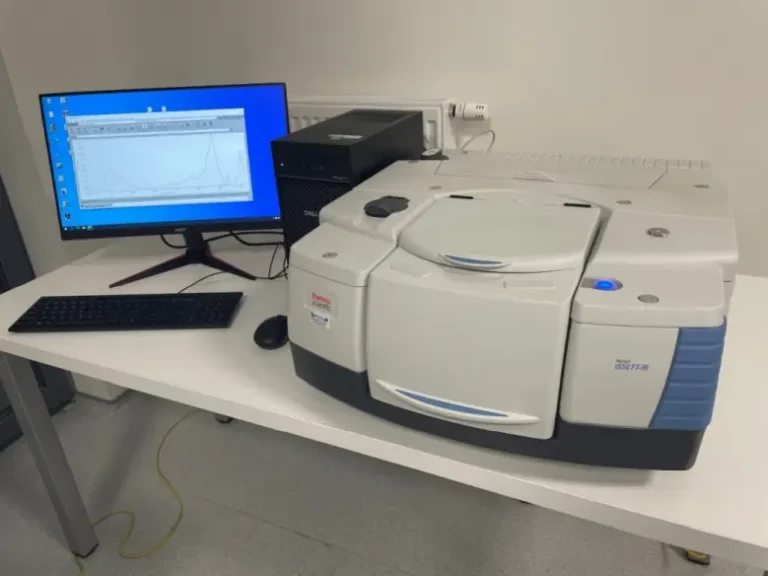
a Nicolet iS50 FT-IR spectrometer
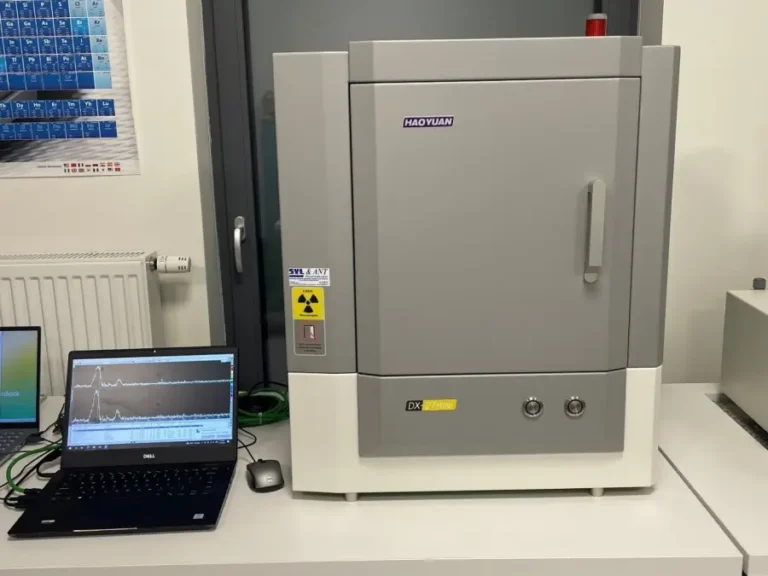
a HAOYUAN DX-27mini X-ray diffractometer
a Linseis STA PT 1600 thermal analyzer
an MKS Cirrus 3 mass spectrometer
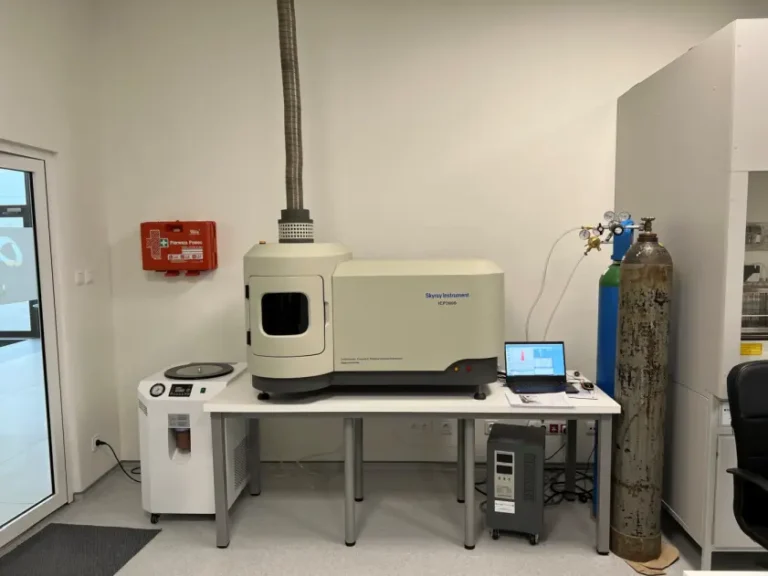
a Skyray Instrument ICP3000 inductively coupled plasma optical emission spectrometer
PRISMA E SCANNING ELECTRON MICROSCOPE
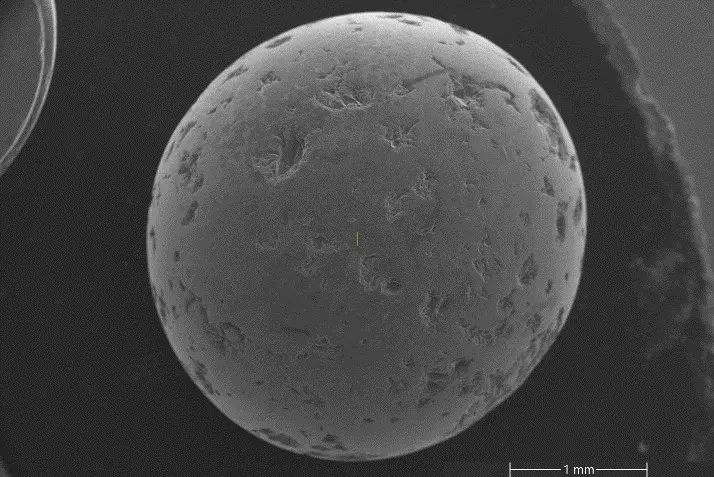
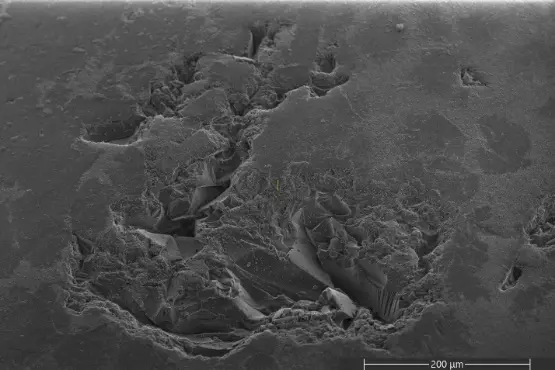
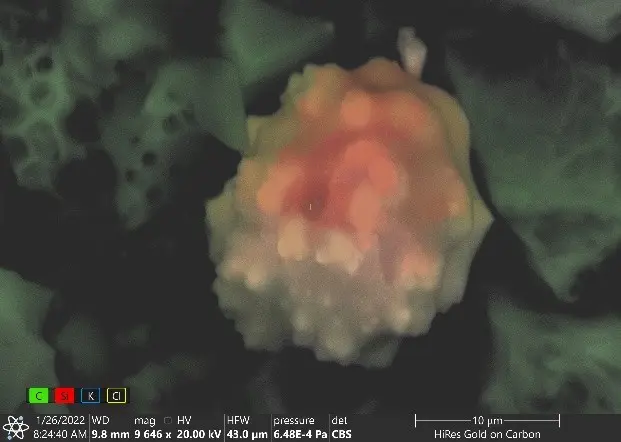
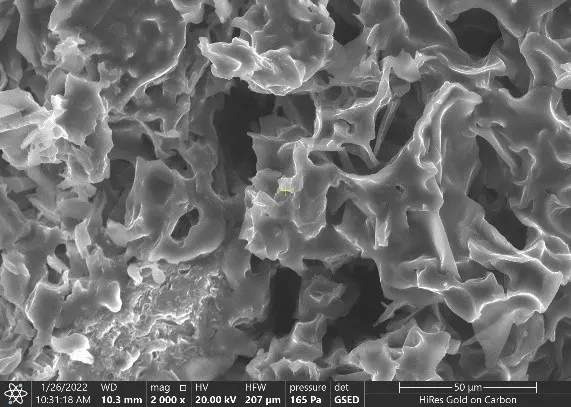
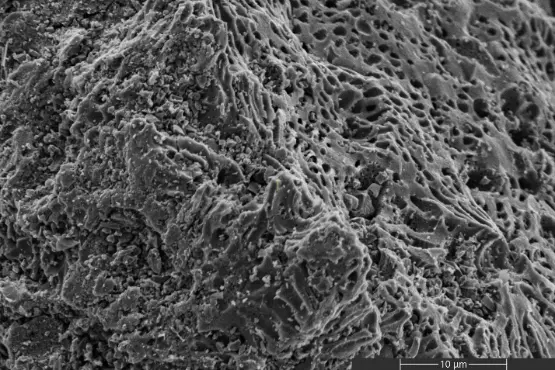
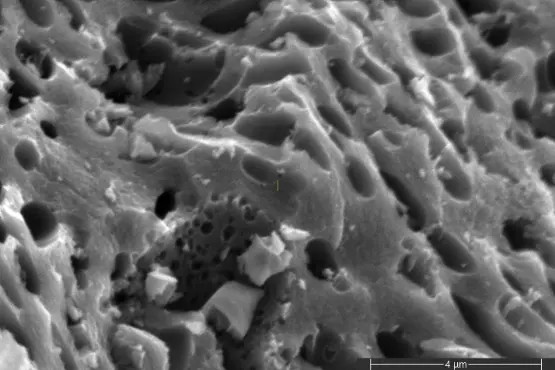
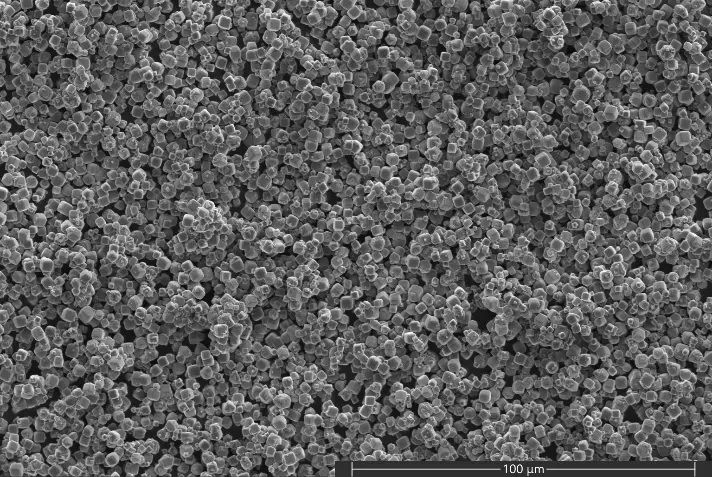
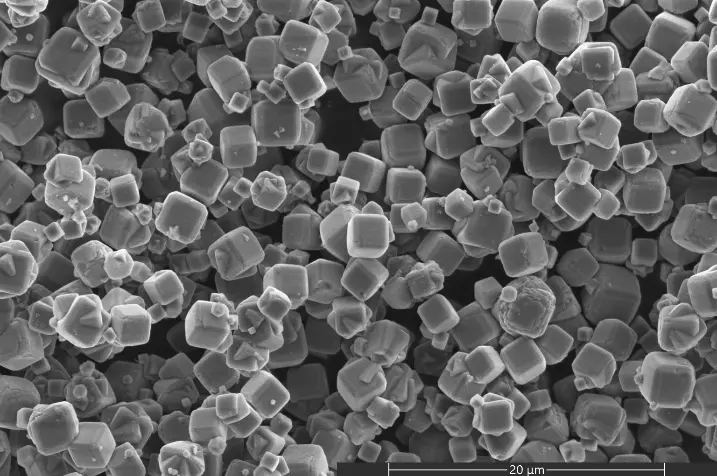
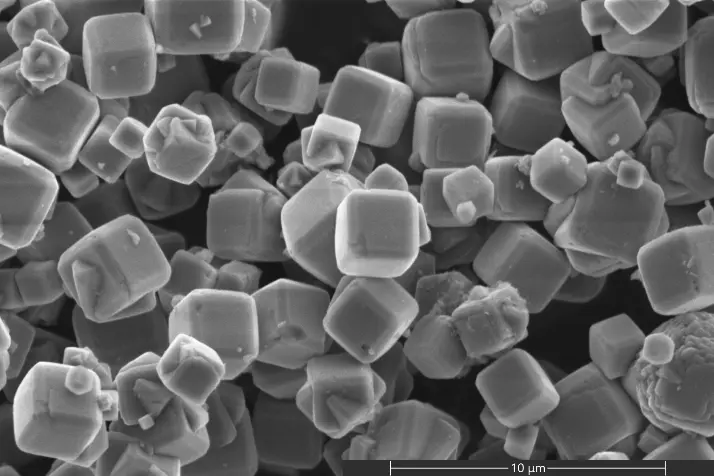
Our laboratory is equipped with a modern, advanced Thermo Scientific Prisma E scanning electron microscope. We offer high-resolution micrographs (JPEG, TIFF) at magnifications of up to 1,000,000×, together with elemental composition analysis. Tests can be performed in high- and low-vacuum modes, in environmental mode, and with SE (secondary electron) or BSE (backscattered electron) detectors. Elemental analysis is performed by energy-dispersive X-ray spectroscopy (EDS) and can be carried out as point, line or area mapping of element distribution on the surface.
Scanning electron microscope imaging is an excellent method for:
verifying surface material defects
determining the morphology, topography and structure of the examined surface
determining local elemental composition and identifying compositional changes across the surface
measuring the size and shape of pores, grains and other particles, as well as coating thickness
PRISMA E SCANNING ELECTRON MICROSCOPE
Advantages of the Analysis
Complete analysis
A complete analysis requires only a small amount of sample.
Speed
The analysis enables very fast determination of the elemental composition of the tested materials.
Accuracy
The analysis allows precise determination of the structure of the examined surface.
Key operating parameters of our microscope:
beam current range: up to 2 µA
accelerating voltage range: 200 V – 30 kV
magnification: from 5 to 1,000,000×
TG/DSC THERMAL ANALYSIS
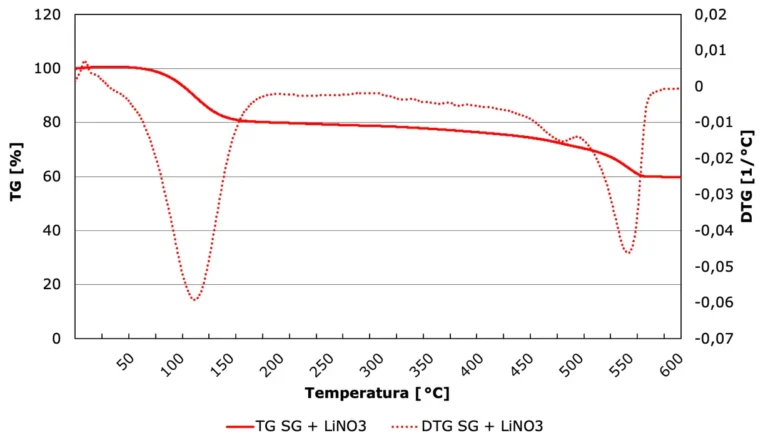
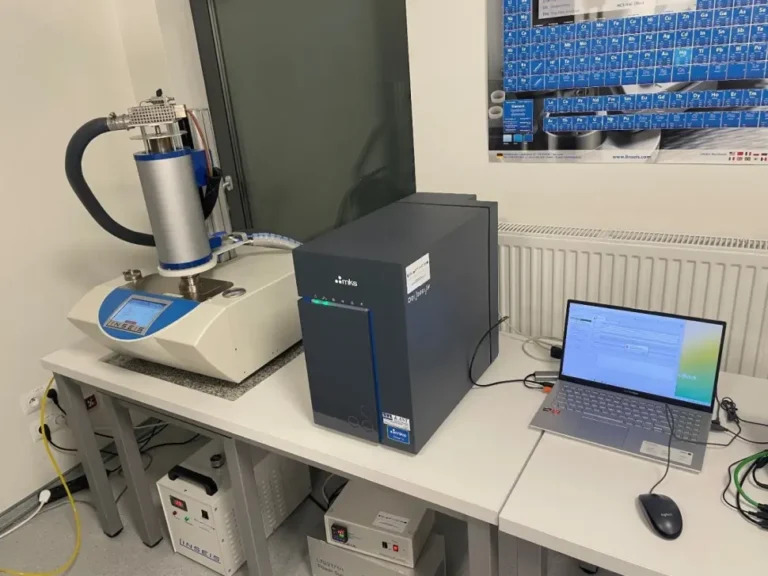
Thermogravimetric analysis with differential scanning calorimetry (TGA-DSC) is a test method that measures changes in sample mass as a function of temperature or time, with simultaneous thermal analysis. TGA/DTG analysis is used to study phase transitions or chemical reactions occurring in the sample during heating or cooling. DSC analysis, in turn, is used to study processes that occur as the material is heated or cooled, or held at a constant temperature. Our laboratory has two modern Linseis STA PT 1600 instruments enabling simultaneous TGA and DSC thermal analysis in an oxidizing (oxygen, air) or inert (argon, nitrogen) atmosphere. Our STA instruments operate in a temperature range from -150 °C to 1400 °C and allow samples to be heated and cooled at different rates.
TG/DSC thermal analysis is ideal for determining temperature points of key importance in materials engineering – evaporation, oxidation, melting, solidification and recrystallization – as well as the energy of phase transitions. A key outcome of the test is information on the maximum operating temperature of the analyzed material, its degradation temperature and its flow temperature. Tests are performed in accordance with internal procedures or relevant standards.
Scanning electron microscope imaging is an excellent method for:
verifying surface material defects
determining the morphology, topography and structure of the examined surface
determining local elemental composition and identifying compositional changes across the surface
measuring the size and shape of pores, grains and other particles, as well as coating thickness
TG/DSC THERMAL ANALYSIS
Advantages of the Analysis
STA analysis provides a large amount of information in a short time
thermal analysis requires no prior sample preparation, and only a small amount of material is needed for testing
TG/DSC THERMAL ANALYSIS WITH OPTIONAL MS COUPLING
We also offer TG analysis coupled with mass spectrometry (MS). Our laboratory has a high-quality MKS Cirrus 3 quadrupole mass spectrometer. Combining these two analyses enables simultaneous measurement of sample mass change as a function of temperature and recording of the masses (ions) of gases released from the sample as the temperature changes. MS analysis is also ideal for, among other things, verifying gas purity and monitoring trace impurities in process gases. Mass spectrometry makes it possible to identify gas composition over a wide range, from sub-ppm levels to percentage levels. The process can be carried out in air, under inert gas, in vacuum or at slight overpressure (0.2 bar).
FT-IR SPECTROSCOPY
Our laboratory has a Nicolet iS50 FT-IR spectrometer capable of measurements across the entire infrared range. Infrared spectral analysis makes it possible to determine chemical properties and identify molecular structures, intermolecular bonds and functional groups present in the tested material. FT-IR analysis is a widely used method for checking compound purity and analyzing the crystalline structure or amorphous nature of materials. It enables assessment of product consistency and verification of compliance with requirements. A unique advantage of this method is the rapid assessment of the chemical properties of samples. Tests are performed in accordance with internal procedures or standards.
X-RAY DIFFRACTION
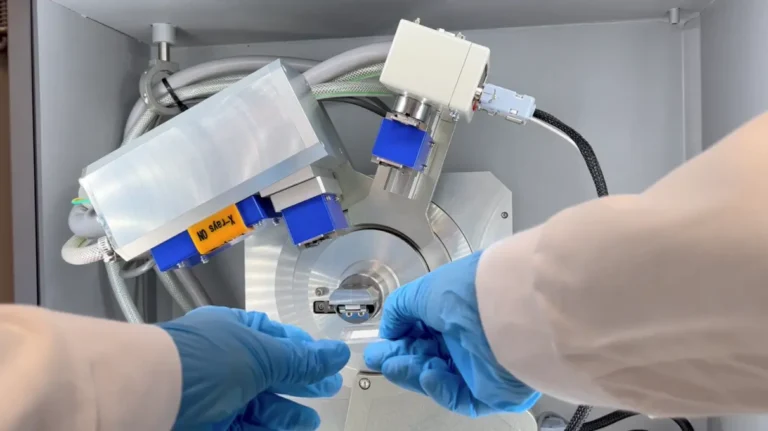
X-ray diffraction is a key analysis in crystallographic research. Our laboratory has a HAOYUAN DX-27mini X-ray diffractometer designed for quantitative and qualitative analysis of crystalline materials. The test is ideal for assessing the crystalline and amorphous phase content of samples, identifying material composition and determining crystal lattice parameters. The analysis requires only a small sample in solid or powder form. Tests are performed in accordance with internal procedures or relevant standards.
X-RAY DIFFRACTION
Advantages of the Analysis
diffraction analysis is relatively fast and requires no special sample preparation
after diffraction testing, the sample can undergo further analyses – X-ray diffraction is non-destructive
X-ray diffraction enables precise determination of phase composition, crystalline phase structure and degree of crystallinity
ICP-OES OPTICAL EMISSION SPECTROMETRY
Our laboratory has an advanced Skyray Instrument ICP3000 inductively coupled plasma atomic emission spectrometer. The instrument is used for highly precise qualitative and quantitative determination of major and trace elements in liquid samples. We also offer digestion of solid samples in a Hanon SH420 graphite digestion system. Tests are performed in accordance with internal procedures or relevant standards.
X-RAY DIFFRACTION
Advantages of the Analysis
very high sensitivity and precision
ability to determine multiple elements in a single test